






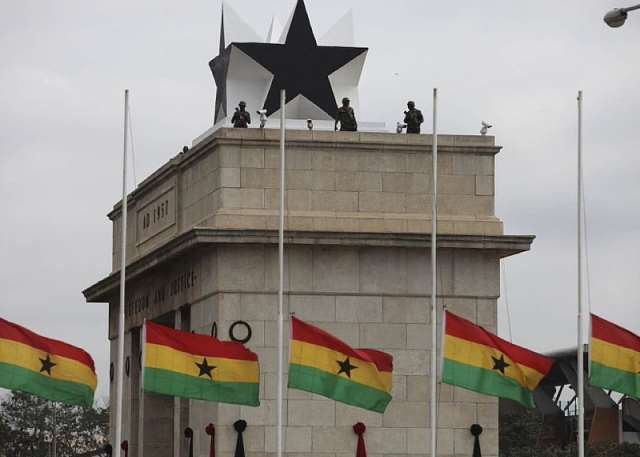
Ghana Mourns! By Dominick Andoh | Ghana is in mourning following the tragic loss of senior government officials in a military helicopter crash at Adanse in the Ashanti Region.
The fatal crash involved a Ghana Armed Forces Z-9 helicopter, which departed from Accra at 9:12hrs on Wednesday, August 7, 2025, with eight persons onboard: three (3) crew and five (5) passengers.
The passengers on board were the Minister for Defence, Dr. Edward Omane Boamah; Alhaji Dr. Ibrahim Murtala Muhammed, Member of Parliament and Minister for Environment, Science, and Technology (MEST); Alhaji Muniru Mohammed, Acting Deputy National Security Coordinator; Dr. Samuel Sarpong, Vice Chairman of the NDC; and Mr. Samuel Aboagye, Former Parliamentary Candidate.
Squadron Leader Peter Anala, Flying Officer Twum Ampadu, and Sergeant Ernest Addo Mensah were part of a three-man crew stationed at the Takoradi Air Force base and deployed to transport the government delegation from Accra to an event at Obuasi.
The Chinese-made Z-9 helicopter went off the radar at about 10:00hrs. Attempts by the military air traffic control to establish contact with them via a functioning two-way radio on-board provide futile after several attempts.
Possible cause of the crash
While the Ghana Armed Forces and National Security authorities are currently conducting investigations into the cause of the crash, analysis of the weather pattern and eyewitness accounts point to key risk factors that might have brought down the Chinese-made aircraft.
Helicopters fly at a lower altitude than fixed-wing aircraft and are therefore exposed to weather hazards that pose a risk to their safe operations. These risks include low visibility and fog, high winds and turbulence, thunderstorms, and lightning.
The Z-9 helicopter’s Visual Flight Rules (VFR) require clear visibility for safe operations. If a navigation system is used, the Z-9 would need to be clear of clouds with at least 800 meters of visibility during the day.
If the helicopter Z-9 was flying very low (either class G or D airspace), as the eyewitness accounts at the crash area indicate, it would require visibility of at least 5,000 meters.
Unfortunately, the weather pattern in the crash area and other parts of the country, typical of August weather in Ghana, was wet, foggy, and cloudy, raising questions about the crew’s pre-departure weather analysis.
“I am sure because of the fog, the pilot didn’t see clearly and hit the trees and eventually crashed into the mountain,” an eyewitness who was among the first respondents to reach the crash scene in the Dampayaw Forest in the Ashanti Region said.
The CEO of Crawley Aviation, Ing. Benjamin Owusu, tells AviationGhana that the weather and the forest in the crash area created moisture that may also have impacted the helicopter’s performance.
“ If visibility is poor, as we have seen this week, and in particular yesterday around the Adanse area, it creates a challenge,” the experienced aircraft safety engineer told AviationGhana.
Yesterday, the weather in the Adanse area was characterized by cloudy and foggy conditions, leading to reduced visibility. Light rain persisted throughout most of the morning. From 07:00 to 11:00 hrs on Wednesday, 7 August, temperatures in Adanse fluctuated between 22 and 26 degrees Celsius. The area had a 20 percent chance of rain, with an average humidity of 89 percent. Additionally, there were light winds coming from the Southwest at a speed of 10 km/h.
Ghana Mourns! | By Dominick Andoh