

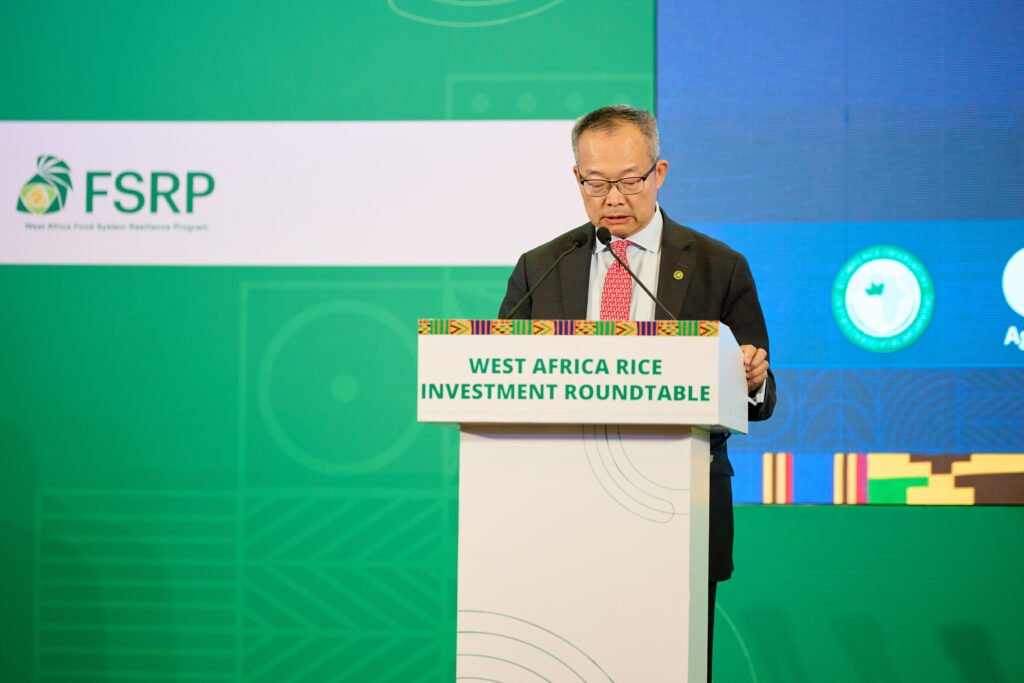
West Africa’s $5bn rice import bill a ‘strategic vulnerability’, World Bank VP warns | The World Bank Group has warned that West Africa’s continuous dependence on imported rice is not only draining billions of dollars from the region’s economies but also exposing countries to growing food security risks.
Speaking at the West Africa Rice Investment Roundtable in Accra, the World Bank Group’s Vice President for Planet, Guangzhen Chen, said the sub-region currently imports about 40 percent of the rice it eats at an annual cost of $5 billion.
“That’s not just an economic headache; it leaves the region exposed,” he told the participants, while lamenting the heavy price West African countries are paying for their reliance on imported rice.
Mr. Chen argued that West Africa, with its rich arable land, water and farming population, should be able to grow most of its own staple food instead of remaining hooked on international markets. He explained that recent rising global prices and fertilizer shortages have shown just how risky that dependence can be.
Mr. Chen was, however, optimistic about the efforts initiated so far by ECOWAS towards boosting rice production. “The ECOWAS Rice Roadmap provides a strong foundation. The Rice Observatory is improving data and coordination. Countries have clear investment plans,” he pointed out, adding that “what is needed now is execution and financing at scale.”
He pointed to the World Bank’s AgriConnect initiative, launched in October 2025, as a vehicle for change. The programme aims to help 300 million smallholder farmers across Africa improve their livelihoods and farming systems by 2030.
Mr. Chen said increasing rice production alone is insufficient; policy reforms, infrastructure, financing, private investment, and market access must also improve.
To support this, the World Bank is investing $1.2 billion through the West Africa Food Systems Resilience Programme (FSRP), expected to benefit 3.2 million people across eight countries. An additional $300–$400 million may be invested in rice value chains in Nigeria, Togo, Burkina Faso, and Guinea.
Still, one of the biggest hurdles, he said, is simple: farmers can’t get loans. Banks treat agriculture as too risky.
“The answer is de-risking,” Mr. Chen said, pointing to tools like loan guarantees and blended finance. “We’ve seen these work. The challenge now is rolling them out faster and more widely.”
Beyond finance, he called for investment in warehouses, mills and transport links. “None of this works if you grow more rice but have nowhere to store it or no way to get it to market,” he said.
With donor budgets under pressure and private investors still cautious, Mr. Chen urged governments not to let the moment slip.
“Everyone talks about food security,” he said. “But the window to actually do something about it—that’s now.”
West Africa’s $5bn rice import bill a ‘strategic vulnerability’, World Bank VP warns | Source: MyJoyOnline | Aviationghana