

By Gabriela Ramos
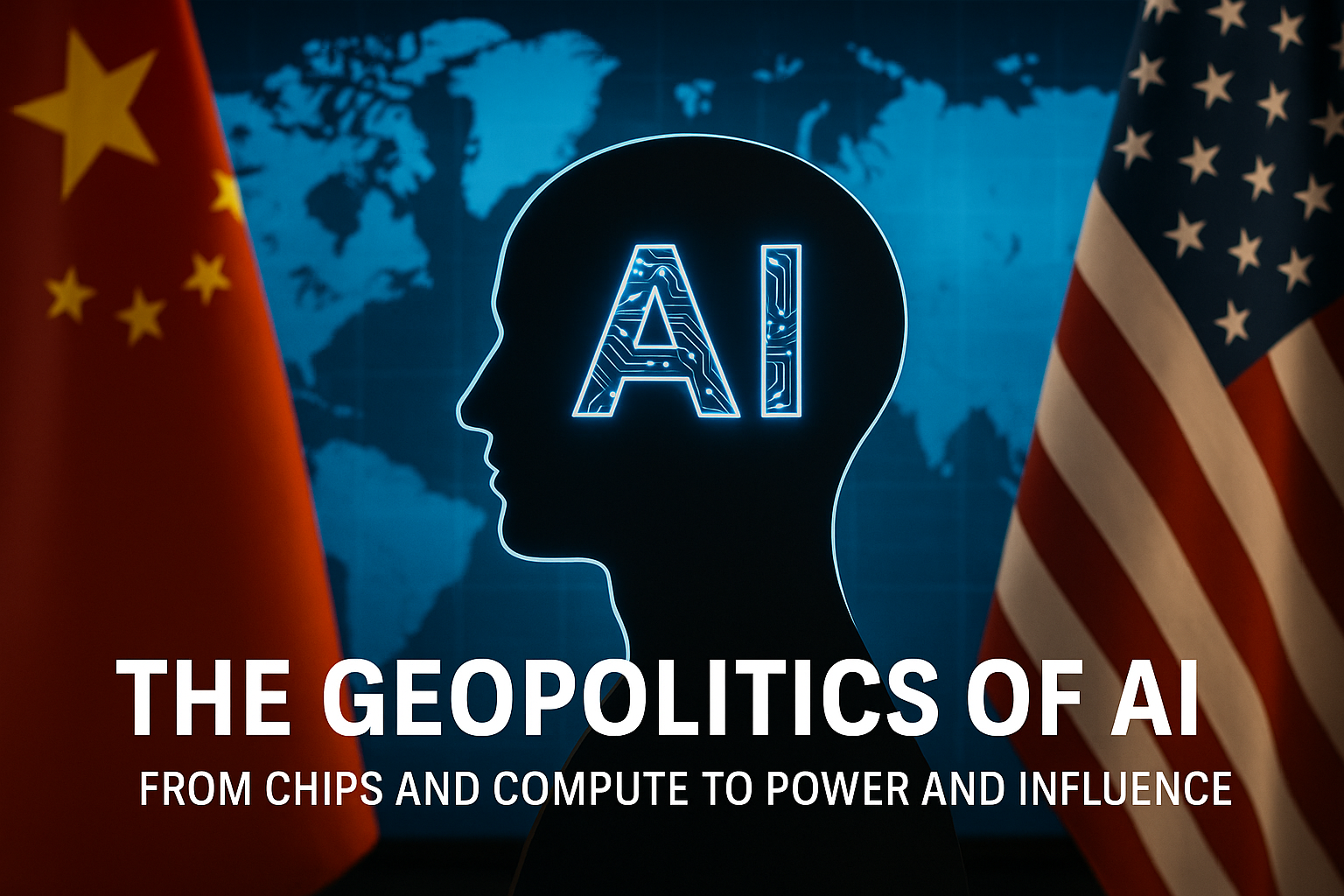
The Geopolitical Drag on AI Governance | PARIS—Last month, China announced the creation of the World Artificial Intelligence Cooperation Organisation, a 38-country platform focused on AI cooperation, bridging the AI divide by supporting innovation and deployment in developing countries. WAICO marks a turning point, but not the one the world needs.
I have long argued that governance is the central challenge AI raises: establishing rules, institutions, and accountability mechanisms capable of containing the very real risks the technology poses and steering its development in ways that deliver positive outcomes for our economies and societies. So far, governments are failing to meet this challenge.
To be sure, efforts to deliver effective AI governance have been made. In 2019, as a G20 sherpa, I brought the then-newly agreed OECD AI Principles to the Osaka Summit for adoption. The following year, the OECD hosted the Global Partnership on AI, which now counts 46 countries as members. While membership is supposedly open, it requires countries to endorse the OECD Principles, even if they had no say in these principles’ creation.
In 2021, UNESCO delivered the Recommendation on the Ethics of AI (I oversaw its creation). While 194 member states, including China, adopted the standard, implementation has been uneven, particularly when it comes to the core commitments of transparency, accountability, and the rule of law. The UN specialised agencies and organisations also have specific AI initiatives.
The release of ChatGPT in 2022 introduced generative AI to the masses, lending new urgency to the AI-governance challenge. The following year, the G7 launched the Hiroshima AI Process, and the United Kingdom convened the first AI Safety Summit in Bletchley Park, followed by a series hosted successively by South Korea in 2024, France in 2025, and India in 2026 (with Switzerland hosting next year). One of the most promising developments of these summits was the establishment of AI Safety Institutes, first in the UK and the US. An international network of AISIs became operational in 2024.
These institutes focused on evaluating frontier AI systems, improving AI risk assessment, and establishing common safety standards. Under President Donald Trump, however, the scope of the US AISI has shifted away from safety, toward national security and strategic competitiveness.
For the Trump administration, robust AI governance is a non-starter. Regulation stifles innovation, the logic goes, and the US can ill afford to fall behind in its race with China for global technological leadership. The same narrative of geopolitical competition has also led the US to impose export controls on advanced chips and computing capacity, as well as restrictions on foreign access to the most powerful AI models.
By some measures, the US still has a clear lead over China. According to the 2026 Stanford AI Index, US private investment in AI reached $286 billion in 2025, compared with $12 billion in China, and the US produced 59 notable models, compared to China’s 35. Nonetheless, the US has legitimate reasons for concern. From DeepSeek to Kimi K3, Chinese models are approaching the capabilities of frontier US systems, often at considerably lower cost. Moreover, China emphasizes open models, which offer developing countries far easier access to AI. And it is working hard to overtake the US in AI research.
But the field of competition extends beyond the AI market. With WAICO, China is seeking to expand its geopolitical influence, not least by becoming the power that writes the AI rules for everyone else. This fits into a broader strategy: since 2013, China has channeled roughly $1.5 trillion into construction contracts and investments in partner countries through its Belt and Road Initiative. It is no coincidence that the founding members of WAICO—which also includes infrastructure investment and technology transfer—are all BRI participants.
China also spearheaded the creation of the Asian Infrastructure Investment Bank, which has yet to match the World Bank or the Asian Development Bank in size, but does demonstrate China’s capacity for—and interest in—institution-building. The US, meanwhile, is doing just the opposite, retreating from some of the institutions that it helped to build, including UNESCO, the World Health Organization, the United Nations Conference on Trade and Development, and the UN Human Rights Council. It has also dismantled the US Agency for International Development and withdrawn from the Paris climate agreement.
The Trump administration’s decision to prioritize national competitiveness over multilateral frameworks has deepened the fragmentation of global AI governance. The establishment of WAICO takes this fragmentation to a new level by institutionalizing a China-led initiative. The US response was not long in coming. According to Reuters, the State Department is preparing a letter urging allies participating in US initiatives—Pax Silica (2025) or the AI Opportunity Statement (2026)—to choose sides in the AI race.
None of these initiatives is fully addressing the core issues that worry people about AI: addictive models that harm children and young people, discriminatory algorithms that entrench inequality, potentially existential loss-of-control risks, national-security and cybersecurity threats, and labor-market disruptions that we can barely assess, let alone manage.
The only power that is attempting to address these issues is the European Union. With the AI Act, the EU has adopted binding rules for the technology’s development and deployment, although it has postponed the obligations on high-risk AI systems. Nevertheless, it has supported developing countries in building frameworks that align AI with human rights. But because Europe is not a leading contender in the AI race, it struggles to turn its normative leadership into global impact. While its track record in other fields suggests that its regulatory frameworks may yet spread beyond its borders, particularly if AI incidents proliferate, we are not there yet.
With the right governance, AI might be able to help address the greatest challenges the world is now facing. But this would require the US and China to embrace a radically different set of priorities from those they are now pursuing. It will require, above all, that they work together to ensure AI delivers for the public good. For now, humanity remains a secondary concern in a race supposedly being run on its behalf.
The Geopolitical Drag on AI Governance | AviationGhana | Project Syndicate