

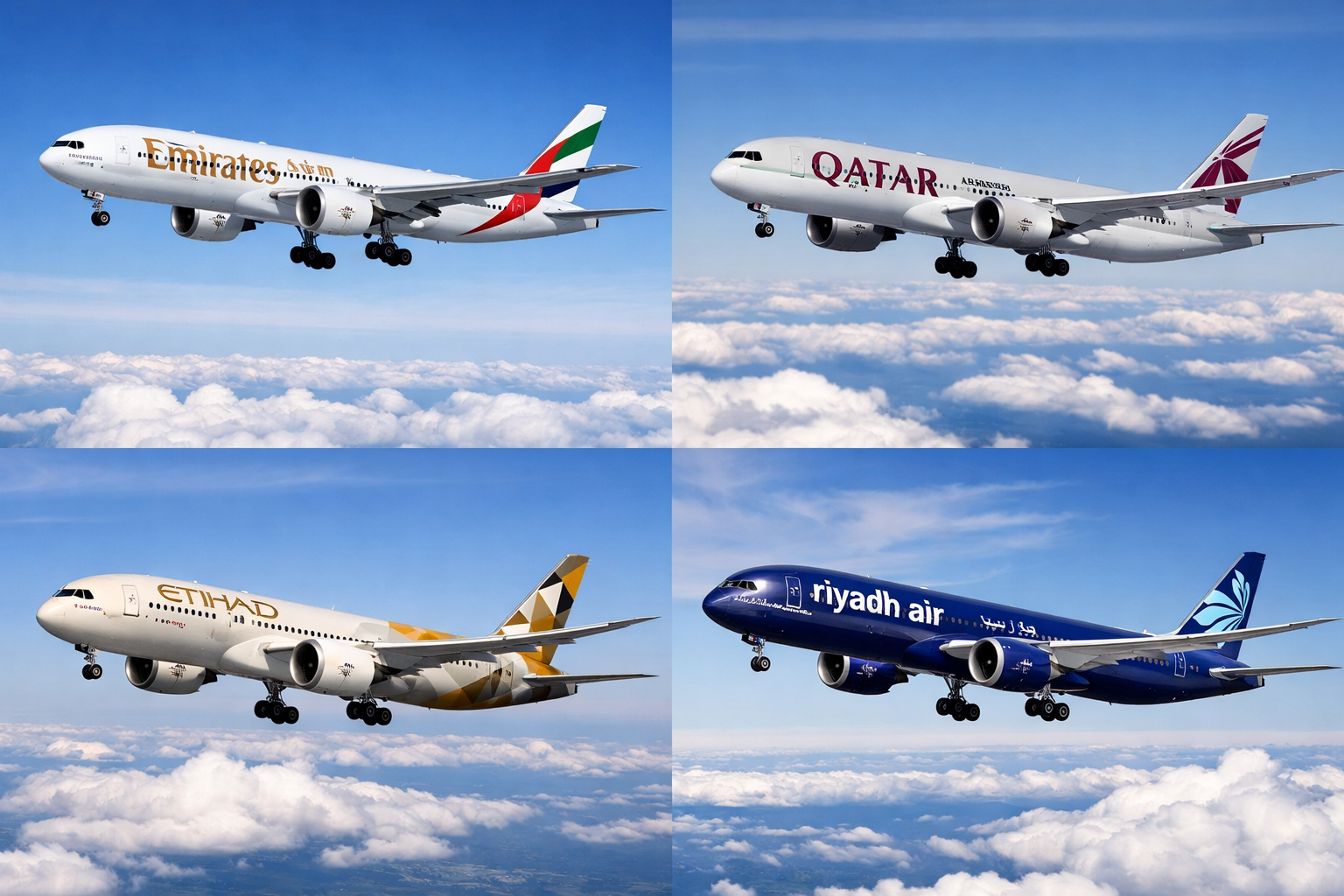
Accra Emerges As Key Hub for Gulf Carriers | By Dominick Andoh
Accra is fast emerging as a strategic battleground for Gulf carriers, as airlines from the Middle East ramp up expansion across Africa in response to shifting global demand and growth opportunities on the continent.
Emirates and Qatar Airways have long maintained strong footprints in Ghana and across Africa, operating extensive networks that connect key cities such as Accra to global hubs in Dubai and Doha.
Their well-established presence has positioned them as dominant transit carriers for passengers travelling between Africa, Asia, Europe and the Middle East.
However, the competitive landscape is evolving. Etihad Airways has announced plans to launch direct flights between Abu Dhabi and Accra, alongside additional African routes, signalling a renewed strategic focus on the continent.
The airline disclosed the development via an official post on its X (formerly Twitter) platform, confirming the launch of March 17, 2027, for the highly anticipated route. The airline, in the same post, announced that it will commence services to key African markets, including Asmara in Eritrea, Harare in Zimbabwe, Kinshasa in DR Congo, Lagos in Nigeria, and Lubumbashi in DR Congo
Aviation experts Sean Mendis, says Etihad’s move reflects a broader post-pandemic recalibration, as the airline seeks to address historical gaps in its African network while leveraging partnerships such as its codeshare with Ethiopian Airlines.
“Etihad is restructuring the airline and route network in the post-COVID era, and its biggest weak spot has been Africa,” he said. “They entered into a strategic partnership and codeshare agreement with Ethiopian Airlines last year to begin building a footprint into African markets, and this Accra service represents the next phase of that expansion.”
Mendis added that weakening demand across some of Etihad’s traditional core markets, including Europe, the Middle East, and Russia, has prompted a strategic pivot. “Africa is a growth market where an aggressive expansion is more logical than deploying capacity elsewhere,” he explained.
Direct UAE market Etihad can tap
Compared to Emirates and Qatar Airways, which have built scale and frequency over years, Etihad is effectively playing catch-up. However, its targeted expansion strategy, combined with efforts to strengthen connectivity through Abu Dhabi, could enable it to carve out a competitive niche, particularly if it leverages pricing, partnerships and network optimisation.
The Ghana-to-the-UAE market grew by 30% in 2025 to around 170,000 passengers, but 45% of those passengers are still flying via indirect carriers, mostly Ethiopian, with RwandAir and Kenya Airways.
Currently, data analysis shows that there is strong demand for nonstop flights to the UAE that Emirates is not capturing right now. However, 47% of Emirates passengers from Accra are connecting onward from Dubai and 73% of Qatar Airways passengers from Accra connect onward from Doha.
Sean Mendis notes that: “Etihad too is targeting passengers connecting to markets such as India and particularly China, where they are launching five (5) new routes to Shanghai, Guangzhou, Chengdu, Hangzhou, and Shenzhen, mostly commencing at exactly the same time as the Africa expansion in March 2027.”
Riyadh Air Plans Accra entry
Adding further momentum is Riyadh Air, which has formally signalled its intention to commence direct flights to Accra. Once operational, this would mark the first scheduled non-stop link between Ghana and Saudi Arabia, reducing reliance on connecting flights and seasonal charters, particularly for Hajj traffic.
The growing interest from Gulf airlines underscores Accra’s rising importance as a regional aviation hub and gateway to West Africa. Strong demand fundamentals, including business travel, diaspora traffic, religious tourism, and trade links, are driving airlines to deploy capacity into the market.
For Ghana, increased competition among these carriers is expected to deliver tangible benefits, including improved connectivity, enhanced service quality and potentially more competitive fares.
More broadly, the surge in Gulf airline activity reflects Africa’s positioning as one of the last high-growth frontiers in global aviation.
African Air Traffic Data
According to the International Air Transport Association (IATA), Africa accounts for 2.2% of the global passenger air travel market, underscoring its relatively small but steadily growing share of worldwide aviation activity.
African airlines recorded a 4.8% year-on-year increase in demand in February 2026, indicating continued recovery and passenger growth.
Capacity expanded at a faster rate of 6.6% year-on-year, suggesting airlines are adding more seats in anticipation of future demand. However, the passenger load factor stood at 74.5%, a 1.3 percentage-point decline from February 2025, reflecting a slight mismatch between capacity growth and actual passenger uptake.
Accra Emerges As Key Hub for Gulf Carriers | AviationGhana | Send all editorial, marketing inquiries, and press releases to AviationGhana.info@gmail.com